

The measurement system that makes you impossible to ignore.
A practical three-level framework for proving the impact of your L&D work. A tester doubled her feedback response rate in week one, off step one alone.
30 day guarantee, full refund, keep the templates.
You’re good at your job. That’s not the problem.
You can build a course, hit a deadline, and point to a catalogue of finished projects. But some of this probably sounds familiar:
- You want to move from development into strategy — and nobody has ever told you where that road actually starts.
- You’ve heard the “L&D needs a seat at the table” talk a hundred times. You’ve never once heard it followed by instructions.
- You know your work should be measurable and connected to the business. You just don’t have the data, the relationships, or the influence to get there. Yet.
- Your CV says “proficient in Storyline, experienced in Rise” — exactly like the CVs of a thousand other developers who can do what you can do.
And somewhere in the back of your mind: if restructuring came tomorrow, what would you actually point to?
That last one isn’t hypothetical for me.
Two weeks before Christmas, I got the call.
Five years into my L&D career, on holiday in the Scottish Highlands, my head of department phoned: I was at risk of redundancy. Two months before my wedding.
When I sat down to make the case for my own value, I had one thing to point to: courses produced. High-quality, well-received courses — and no evidence that any of them had changed anything. Like a sales team reporting calls made instead of sales landed.
The business wasn’t being unfair. It was looking at a function that couldn’t draw a line between its work and an outcome. When budgets tighten, that’s the function at risk.
I built this system so I’d never be in that position again. Then I tested it in two more organisations — different sizes, cultures, and countries — to make sure it wasn’t a one-company fluke. It wasn’t.
What someone had to say about the implimentation
"Adam's measurement framework makes learning analytics accessible without sacrificing meaningful insight. His framework helped turn measurement from an abstract concept into something stakeholders immediately understood.
— Brittany Cowan, Founder | Cowan Learning Solutions
The simplicity of [this] measurement model is what makes it so powerful. Adam removes the complexity from learning measurement while preserving the data that actually matters. His approach creates buy-in because leaders can immediately understand how learning connects to business outcomes.
This is the kind of measurement framework organizations will actually use—not because it's simple, but because it's practical."
Now imagine the same question — with a different answer.
“What difference did your work actually make?”
Six months from now, that question could be the one you want to be asked. Because you’d have:
- A consistently high learner feedback response rate — real volume, not the trickle most teams get
- Trend data you use to visibly improve your products over time
- Manager-validated evidence of behaviour change, in managers’ own words
- Before-and-after views of learner confidence for your highest-stakes courses
- A documented process you can point to in any job interview, internal review, or client pitch
That last one changed my career trajectory more than the data itself. The system — the fact that you built it and run it — demonstrates you think beyond completion metrics. That’s what makes you harder to ignore. And harder to cut.
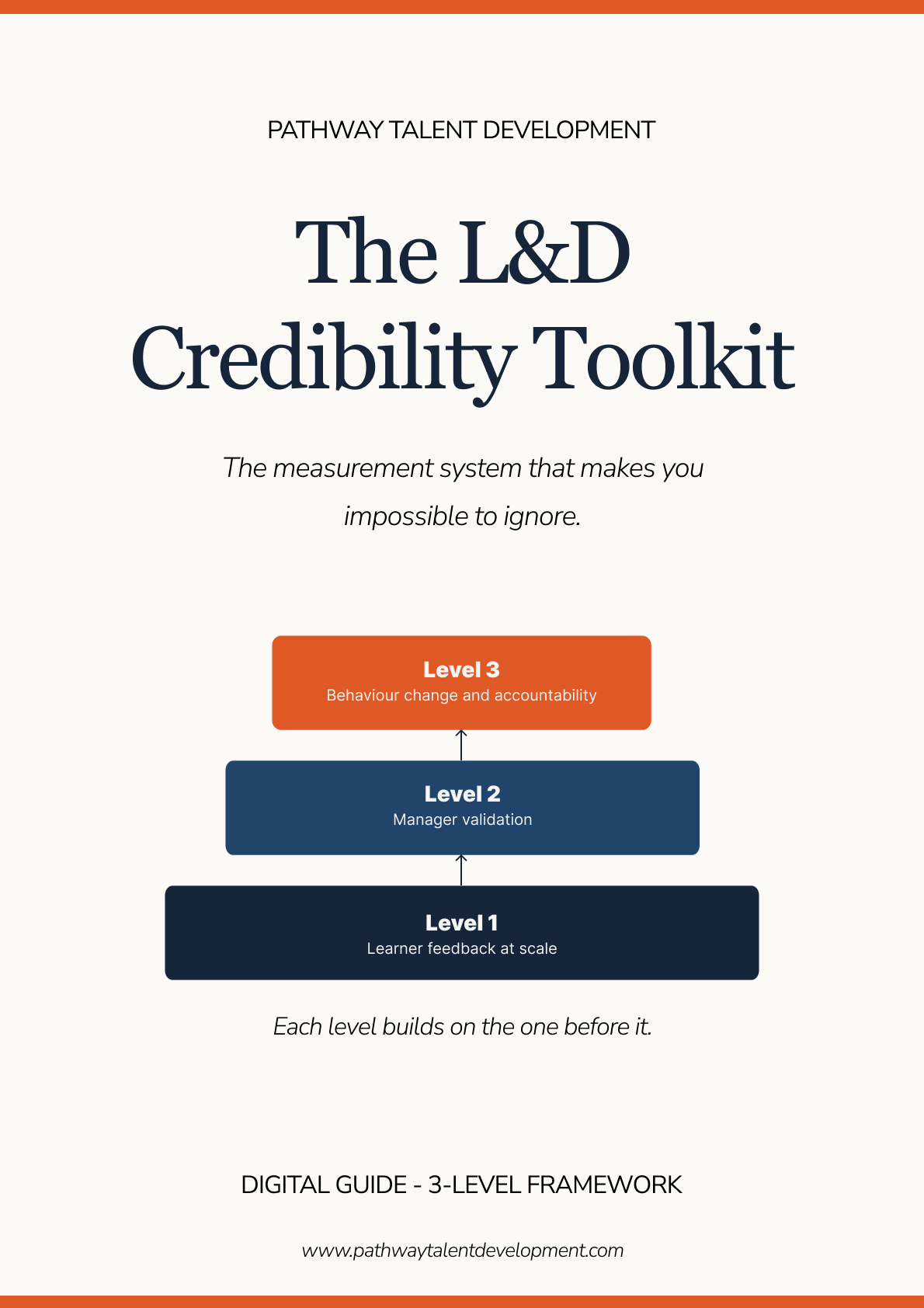
Three levels. Implemented one at a time. Each one builds on the last.
-
Level 1
Learner Feedback at Scale
Five questions, embedded where learners already are. Captures trends across every course you ship. This is where you start — today, with no permission needed.
-
Level 2
Manager Validation
Two automated emails and one two-minute form. Managers corroborate what learners report. Your data stops being opinion and starts being evidence.
-
Level 3
Behaviour Change & Accountability
A commitment loop between learner and manager for your highest-impact courses. Before-and-after proof of what actually changed.
Level 1 alone puts you ahead of most L&D teams. The levels compound from there.
Everything you need to go from zero to running system
- Start on Monday, not “when you’ve got time” 27-page implementation guide — The full three-level framework in plain language. No stats, no research background, no blank page.
- Stop getting shrugs on your feedback forms The exact 5-question learner form — The questions, and why each one earns its place. Step one alone doubled a tester’s response rate in week one.
- Ask a busy director for validation without sounding needy 5 copy-paste manager emails, with automation triggers — The words are already written. Paste them once and they fire on their own.
- What to do when managers ignore you The section most products in this space skip — Because it will happen, and the whole system shouldn’t collapse the day it does.
- Evidence behaviour change without a research team 4 Level 3 commitment loop templates — Level 3 stops being the level everyone talks about and nobody actually reaches.
- Turn responses into a sentence a director cares about The analysis routine — What to look for, how often, and how to use AI on it without handing over something you shouldn’t.
- Get your Friday afternoons back The full Level 3 automation workflow diagram — Set it once and it keeps producing evidence while you do your actual job.
Three years and 10,000+ pieces of learner feedback, compressed into something you can run in a fortnight.
Get your Toolkit Package30 day guarantee, full refund, keep the templates.
What this won’t do — because I’d rather tell you now
This is not an ROI calculator. It will not produce a pounds-and-pence figure for your training, and I’d be suspicious of anyone selling you a formula that claims to. What it produces is the layer underneath: learner evidence, manager validation, and documented behaviour change — the foundation any credible business-impact conversation is built on.
It’s also not a plug-in. It’s a system you build — deliberately designed so one person can build it, level by level, without a budget. The guide gives you every template and every step. You bring the follow-through.
What early readers said
At my previous job I had started to initiate this toolkit into our learning approach as a developer. I worked with our deployment manager to change the feedback forms to be an MS Form rather than being directly on the LMS [as directed in the toolkit]. After only a couple of weeks we saw a substantial increase in the number of feedback forms completed by learners — which provided us with better data to work with.
— Beth, Digital Learning Design & Facilitator
Adam's measurement framework makes learning analytics accessible without sacrificing meaningful insight. His framework helped turn measurement from an abstract concept into something stakeholders immediately understood.
— Brittany Cowan, Founder | Cowan Learning Solutions
The simplicity of [this] measurement model is what makes it so powerful. Adam removes the complexity from learning measurement while preserving the data that actually matters. His approach creates buy-in because leaders can immediately understand how learning connects to business outcomes.
This is the kind of measurement framework organizations will actually use—not because it's simple, but because it's practical.
It provides clear structure for validating learning beyond just “did you learn something” — which is what a lot of L&D freelancers and consultants are missing.
— Jonathan, Founder | Lystone Ltd
Love the conciseness of the 5 learner questions and the manager emails with automations.
— Viv, Learning and Development Consultant
Questions people actually ask
“Managers in my organisation don’t have time for this.”
They don’t need it. Level 2 asks a manager to read two short emails and spend two minutes on a four-question form. The system is designed around the assumption that managers have no spare time — and there’s a full section on what to do when they don’t respond anyway.
“My courses only go out to a handful of people.”
Covered. The guide includes a specific rule for small cohorts — when to stop treating feedback as trend data and how to read it qualitatively instead.
“I don’t control our LMS. Can I still do this?”
Level 1 requires nothing but a form tool and a spreadsheet — you can start this week without asking anyone. Levels 2 and 3 use automation your LMS team almost certainly already has; the guide tells you exactly what to ask them for.
“Is this just Kirkpatrick repackaged?”
No — and the guide explains why Kirkpatrick never stuck for me as a practitioner. This is narrower and more opinionated: a system you can actually run solo, rather than an academic model you admire from a distance.
“How long until I see something useful?”
Level 1 can be live on one course within a week. Useful trend data follows as responses accumulate — and the first monthly leadership report is usually the moment people around you start noticing.
“What if it’s not for me?”
As this is a digital product, it can’t really be returned once you’ve downloaded it. That said, if you’re having reservations before buying, feel free to connect with me on LinkedIn — I’m more than happy to have a conversation and help you work out whether it’s the right fit for you.
“Will it still be up to date in six months?”
Yes. As I refine the framework and implement it in more companies, I’ll send updated versions to everyone who’s already bought — at no extra cost. The version you purchase today will only ever get better.
The question is when you’ll be asked — not if.
“What difference did your work actually make?” Every L&D professional eventually faces that question — in a restructure, an interview, or a pitch. The only good time to build your answer is before it’s asked.
Get your Toolkit Package30 day guarantee, full refund, keep the templates.